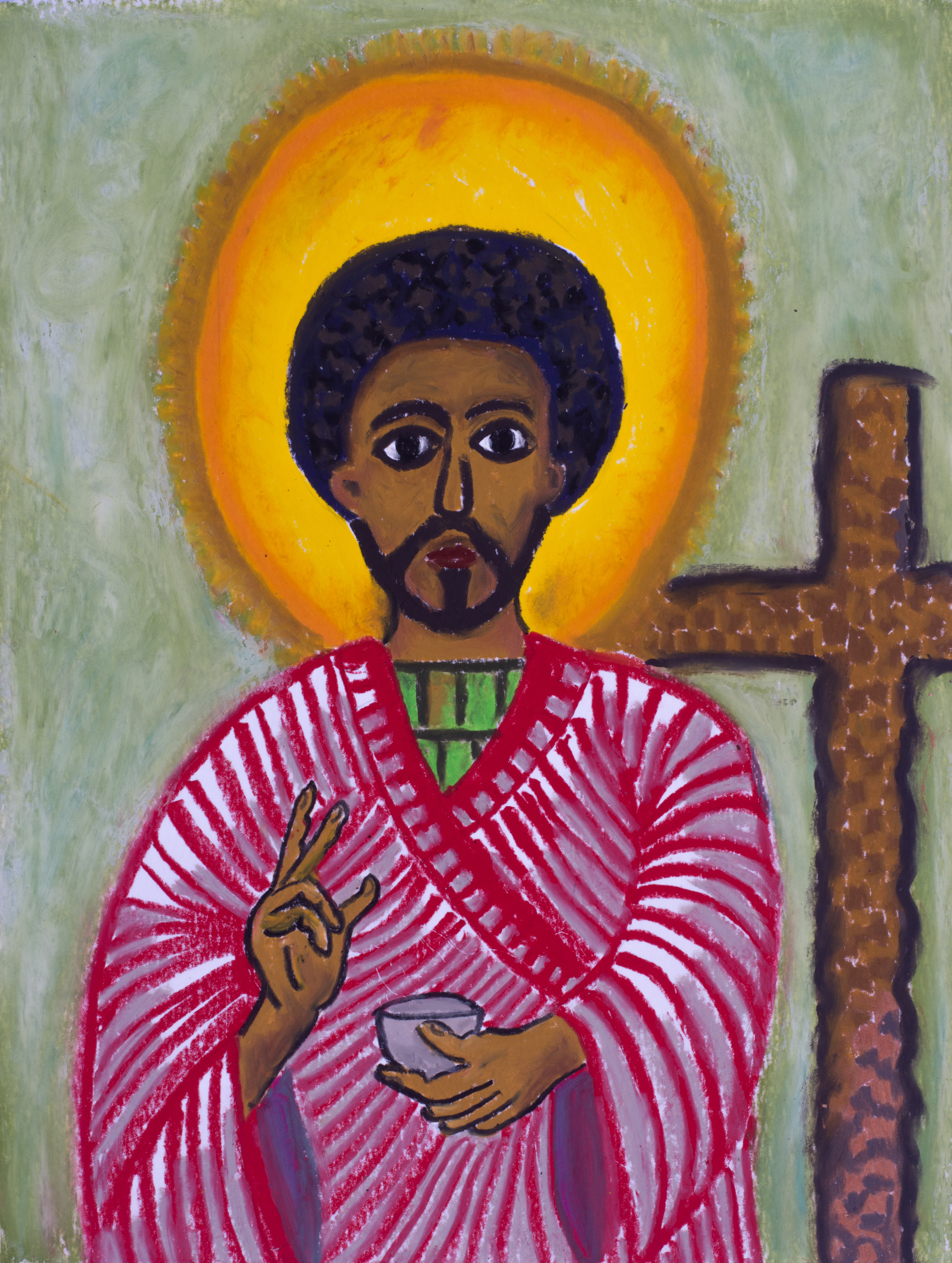
“They are called to build bridges between the Church and the world, and to be an expression of the unconditional love of God.” [Scottish Episcopal Church, 2012]
“Deacons are agents of the church in word, action, and attendance, who lead the people of God in carrying the light of Christ into places of darkness.” [North American Association for the Diaconate]
The recent revitalised understanding of diakonia means that many churches have moved away from the idea that the diaconate is an inferior order dealing with social welfare activities to free up the other orders of ministry to deal with a more ‘spiritual’ ministry. The diaconate is increasingly seen as a full, equal, and distinctive order of people attending to the business of diakonia under the oversight of the bishop and presbyters in a threshold ministry that brings together liturgy, proclamation and service to the world (as it is believed, it did in the early centuries of the Church), particularly in time of crisis in contemporary society.
“The Early Church combined liturgical ministry with social responsibilities without neglecting either of the ministries. This elicits the question, what can the interactionist ministry of the deacon contribute to effective ministry in times of crisis? On the assumption that the deacon is involved in both the sacramental ministry of the liturgy of the Last Supper and provision of social services, what kind of diaconal ministry is suited for urbanisation and the subsequent crisis such as the displacement of people and redefining of spaces?” [Klassen, Louw and Muller, p. 163]
Recently, in 2019, the Scottish Episcopal Church changed its ordinal to reflect both the regained understanding of the deacon as one sent, commissioned, and mandated as an operative of the Church focussed on the proclamation of the Kingdom of God and also the long accepted function of the diaconate to serve and advocate for the needy:
“In the name of the Church, deacons are sent to declare the kingdom of God and to care for those in need, serving God and the world after the pattern of Christ. They have a commitment to outreach and witness, advocacy and prophecy, flowing from their historic ministry for the poor, needy and sick, and seeking out the careless and indifferent. They are called to build bridges between the Church and the world, and to be an expression of the unconditional love of God.” [Scottish Episcopal Church, 2012, p. 2]
The deacon as part of the three-fold order of ministry
The Anglican Church has a three-fold order of bishops, priests and deacons.
Currently it has a process of sequential ordination: all are ordained deacon first, then some are later priested and later still a few are ordained to serve as bishops. However, the diaconate remains at the foundation of their ministry.
Those that are later to be priested are often called ‘transitional’ deacons, but this is an unhelpful and inaccurate term because the diaconate is permanent for bishops and priests. They do not ‘change’ from a deacon into a priest – a priestly ministry is added to their continuing diaconal one.
Because currently those called to become priests are rarely deacons for longer than a year, they do not have the opportunity to deeply inhabit their diaconal orders and so the character of the diaconate for them can become neglected after priestly ordination. Further, the danger is that such a short period of time can end up as a token occasional nod to diaconal ministry, rather than being something deeply held and underpinning their priestly and episcopal ministry.
The Church has a separate set of selection criteria for distinctive permanent deacons, which can be helpful when discerning vocations.
How we understand authority and leadership in relation to deacons is related to their place in the three-fold order of ministry, namely:
Deacons are called to work with the bishop and the priests with whom they serve as heralds of Christ’s kingdom. They are to work with their fellow members in searching out the poor and weak, the sick and lonely and those who are oppressed and powerless. Deacons share in the pastoral ministry of the Church and in leading God’s people in worship.
Theologically, a priest’s ministry is an extension of the bishop's, but in reality, he or she can function and preside at sacraments on their own. In contrast, a deacon cannot preside at the Eucharist on their own, just as one cannot be a practicing Christian on one’s own outside of the church.
In formal liturgical traditions the deacon stands on the right of the bishop (or priest), a position which reflects their relationship. The term “right-hand man” (or woman) indicates someone who works closely with the person in overall charge; someone who is trusted and given a collaborative share in their authority.
Diaconal leadership expresses something important about the foundations of apostolic leadership. All bishops, priests and deacons should embody and proclaim for all to see what is true of the whole body. All the faithful are marked by baptism and share in the messianic identity of Jesus as Prophet, Priest and King, an identity Jesus gives to his Church because it is his Body and one with him.
In a very real theological sense therefore the authority bishops, priests and deacons exercise are not their own and must not get confused with power as the world understand it.
The diaconate as an order of transformation
The Methodist deacon, David Clark (2023, pp. 102 ff), makes an interesting distinction between the order of the presbyterate as being an order of continuity (having care of and celebrating the theology and tradition of the institutional Church and working to help the gathered people of God live and work as part of the Kingdom of God through worship, learning and pastoral care) and the order of the diaconate as an order of transformation (being part of a movement to bring the gifts of life, liberation, love and learning and servant leadership to transform society and the world).
Clark argues that the balance between continuity and transformation is needed because continuity alone leads to stagnation and introversion, a focus only on transformation tends to fragment and weaken.
The unmaking of the menial transitional deacon
The new understanding of diakonia (see The meaning of diakonia) stimulated by Collins’s semantic and exegetical work on the New Testament diakon- words has thoroughly demolished the view that the deacon is the ecclesiastical equivalent of a menial and at the same time ended the idea that the Seven in Acts 6:1-7 were deployed to organise a soup kitchen. Similarly, the idea that the deacon is a transitional deacon – a priest in training – and in this phase expected to exhibit the demeanour of an abjectly humble priestly apprentice is totally inappropriate.
Generally, though various Anglican communions have considered the idea of the direct ordination of presbyters without an intervening transitional diaconate, the likelihood is that there will be an insistence that the transitional diaconate will remain, even if the practice of the presbyter remaining a lifelong deacon and a bishop remaining a lifelong deacon and presbyter is seldom explicated and is theologically unexamined.
Avoiding the social-work cul de sac
Because of the record of the past millennium and a half of misconstruing a deacon’s function there is still a tendency to pigeonhole permanent deacons as social workers or food bank organisers or justice advocates.
The new understanding of diakonia sees this as a dead end. The deacon’s work is the business of diakonia in its fullness. It is not restricted to these particular good works or the organising of these good works. It may just as well be evangelism or confirmation instruction or pastoral visiting or whatever.
This is not to say that the sending out of deacons to do precisely social, economic, welfare and justice organising is not to be encouraged, and in the present Southern African context may well be a growing priority. But it must not been seen as the sole characteristic of the distinctive diaconate.
Foundational principles for a theology of the diaconate
Any renewal of the diaconate should be grounded on:
- a theological foundation that must, inter alia, be linked to a theology of the baptismal vocation of all Christians, and
- an understanding of the diaconate’s relationship to the orders of presbyter and bishop and to the so-called lay-ministries,
- must take into account the revised understanding of the meaning of diakonia as the activities of mandated, commissioned persons who are operatives of the Trinity who calls all people to be servants of the kingdom community.
Clark (2023), in distinguishing between the leadership work of bishops, presbyters and deacons, sees the bishops as an order of unity, the presbyters as an order of continuity and the deacons as an order of transformation.
As an institution, the church is primarily a community of place, of neighbourhood, where people gather to worship, learn and socialise and where, in worship and sacraments the church recalls and celebrates its Christian legacy and teaches its members on the practical implications of the gospel and exercise of the gifts of the kingdom community. The danger of the church as institution is stagnation and introversion, exacerbated by the ongoing secularisation of society which weakens the institution’s ability to influence society. However, the Church is also a movement of transformation, and it is the people of God active in the world who are the diaconal church’s essential resource for mission and engagement in, and transformation of a variety of non-neighbourhood communities of practice.
The basic ministry of the baptised
The ministry incumbent on all the baptised is well expressed in Anglican Communion’s ‘Five Marks of Mission’:
- To proclaim the Good News of the Kingdom
- To teach, baptise and nurture new believers
- To respond to human need by loving service
- To transform unjust structures of society, to challenge violence of every kind and pursue
peace and reconciliation - To strive to safeguard the integrity of creation, and sustain and renew the life of the earth.
All Christians are, without exception, called to this diakonia, this ministry. Humble ministry and service to all in need is the duty of all Christians and not a specific mark of the diaconal ministry performed by deacons.
An ordained ministry
“The particular ministries of presbyters and deacons can only be understood within this context, as focussing, expressing and enabling the ministry of the whole people of God.”
So states a 2004 Methodist Church document on What is a deacon? (p. 3). A theology of the diaconate must therefore be clear on what marks the special nature of the ordained ministry to be performed by deacons that assists the people of God to do this ministry, this diakonia. An attempt to express this position is found in these statements by the Anglican Church of Canada (2016, pp. 18, 19):
“Some are called, equipped, and ordained to embody diakonia as deacons, to exemplify to the faithful what it is “to serve all people, especially the poor, the weak, the sick, and the lonely.” As such, they serve as icons of Christ, inviting us into proclamation and service of the gospel for the sake of the world.”
“Ordination as a deacon is an affirmation by the church that an individual is being called to this distinctive ministry of service and agency, gifted and equipped to inspire and mobilize others into ministries of service, healing, and justice. They become sacramental signs of the presence of Christ in places of need and risk and vulnerability, in the faces of strangers and friends alike.”
Operatives of the Kingdom
“The weight of the Biblical and historical evidence is that deacons are to be seen as mandated, commissioned persons who are operatives of the Trinity who calls all people to be servants of the kingdom community. They go out to bring people in across the threshold. They go out to encourage the faithful, to stand by them, as they do the work of the Kingdom. They go out to reach the unreached and the lost.
In military analogy they lead the ground troops. In espionage analogy they are the spies and reconnaissance agents of God in the world, sabotaging the forces of evil, building up networks of resistance in all spheres of society, setting up liberated zones of the Kingdom. And they report back home on what they have found and done to be re-supplied and re-directed for further missions.
A contextual ministry
The original deacons were not assistant presbyters. They had leadership of a Trinitarian commission that was both Church facing (in their liturgical role, in engaging the people of the Church in communal transformation, and in equipping and enabling), and world facing (as a catalyst, within the changing world contexts, working for the spread of the Kingdom, resisting injustice and lies, serving as intermediaries, bridge builders, network hubs, and partnering with what is good and positive in cultural and civic movements, and disrupting the complacent).
What that means in Southern Africa in the third and subsequent decades of the 21st century is hard to prescribe, given the rapidity of the changes in context. Indeed it is perhaps of the essence of a restored diaconate that its roles and functions must be constantly changing and responding to the context. This has consequences for the Church, for institutions that do not change, die. It was not for nothing that the Church of England named its 2001 report on the diaconate For such a time such as this.
To take some changing context issues that we are all grappling with at this time. On a massive scale there is climate change and ecological catastrophe (and to what extent is every congregation of the Church active here (and not diminishing the good work of ‘Green Anglicans’)), the hideous spectre of unemployment and lack of income generating work, a society festering with corruption, the social media, so full of promise but rapidly corrupted to be the purveyors of misinformation, disinformation, and malinformation (which congregants need to be informed about and armoured against), the collapse of effective education for a majority of children, and the list goes on. It is in this world that the world facing work of the diaconate must respond to.
Given the massive challenges of the contemporary Southern African and worldwide context it is important that deacons be not seen as solitary outriders and there have even been suggestions that a permanent diaconate should be seen as a kind of religious order, with both the duties but also the support and collegiality that such provides. The Methodist Church uses this religious order language (Methodist Church 2004, p. 11):
“Methodist deacons are not only members of an order of ministry but also members of a religious order known as the Methodist Diaconal Order (MDO).”
This suggests that a theology of the diaconate will need to be flexible and from which it will be difficult to lay down a prospectus, which means in turn, that definitions of the diaconate and the ordinals used at their ordinations need to be broad, and inclusive of many possibilities.
Two final quotations:
Association for Episcopal Deacons (2015)
“A deacon is a baptized person called and empowered by God and the Church to be a model of Christ’s servant ministry for all people. As agents of God’s compassion and reconciling grace, deacons are missionaries to the world and messengers to the Church of the world’s needs, hopes, and concerns. In the Church, deacons call forth, empower, and inspire the baptized to respond to these needs. The role of the deacon in liturgy mirrors this role of the deacon in Church and world. Deacons are living symbols of Christ’s presence as they embody Christ’s servant ministry and point to the presence of Christ in those they serve.”
Scottish Episcopal Church (2018, p. 8)
“Deacons are heralds of the Gospel, called to proclaim and make visible God’s love in word and deed. They seek out those in need to bring them the good news of the Kingdom, and bring the concerns of the world to the attention of the Church and its congregations, reminding them of their call to serve others in love in their mission to the world.”